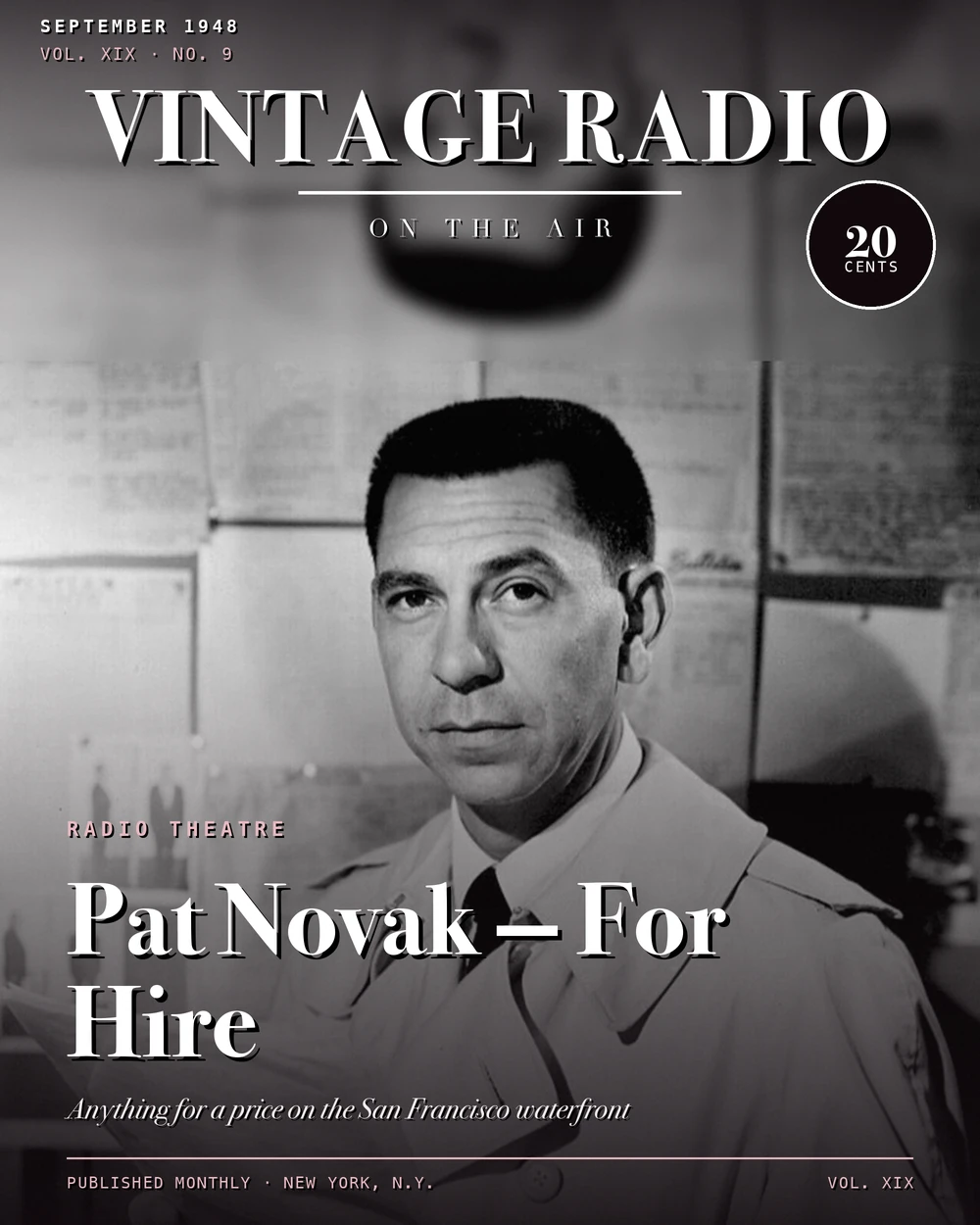
Pat Novak – For Hire
Where It Came From
Jack Webb was twenty-six years old and sharing an apartment with a philosophy graduate named Richard Breen when the two of them put together Pat Novak – For Hire at KGO in San Francisco. The show premiered on August 22, 1946, under the sponsorship of Gallenkamp's Good Shoes — billed initially as "The Gallenkamp Shoe Show," with press ads featuring Miss America 1946, UCLA graduate Marilyn Burferd. It aired only on the ABC West Coast network, which meant most of the country never heard it during that first run. The people who did hear it encountered something unlike anything else on the dial.
Breen brought unusual credentials to crime radio. He had attended Fordham University on a scholarship, edited the student newspaper The Ram, and earned a master's degree in philosophy before serving in the Navy in the Pacific during World War II. He wrote the Pat Novak scripts with what can only be described as sassy, brassy, pent-up fury — dialogue that sounded like it was one bad day away from going completely off the rails. That energy is what made the show.
The premise was simple: Pat Novak runs a small waterfront operation out of Pier 19, renting boats and, as the opening monologue put it, anything else that sounds like money. Every episode opened with a foghorn and the sound of Novak's footsteps on the pier before Webb's voice came in: "Sure, I'm Pat Novak… for hire." Every episode ended with the same phrase leading into Novak's wrap-up: "Well, Hellman asked only one question…" The rigidity of the formula was part of the joke — and the show knew it.
What Made It Sound Like Nothing Else
The show was the vanguard of radio hard-edge, so hard-boiled it tipped into high camp. That description is exactly right, and it's not a criticism. The metaphors Breen wrote for Novak are deliberately, magnificently ridiculous. Sample: "The street was as deserted as a warm bottle of beer." The show built its identity on lines like that — delivered in Webb's flat, matter-of-fact voice, which made them land harder than any dramatic reading could have managed.
Each episode ran the same formula with minor variations. A client hires Novak. A beautiful woman appears. Someone gets murdered. Novak becomes the prime suspect — the patsy, as the show consistently called it. Thugs beat him up. Then Inspector Hellman, a brutish police detective, beats him up again. Novak's friend Jocko Madigan, an ex-doctor and devoted drinker, dispenses bleak wisdom along the way. Jocko's standard parting line at the end of their initial conversation was "Good night, Lover," delivered after a long philosophical monologue — and the show's description of Jocko's condition was that "the hangover is the price of being sober." This is the register the show operated in throughout.
Jack Lewis played Jocko and John Galbraith played Inspector Hellman in the original West Coast run. The whole cast leaned into the show's peculiar tone — presenting the material with complete seriousness, which was the only way the comedy could work. Listeners who came for a straight crime drama got something stranger and more interesting.
What Happened When Webb Left
Gallenkamp's Shoes dropped its sponsorship after a 52-week contract, partly because of a labor strike and a public relations controversy. KGO kept the show running as an unsponsored program. Then, in the spring of 1947, Webb and Breen both departed — apparently after Breen had a falling out with KGO management — and the network tried to continue without them. Ben Morris took over the role of Pat Novak and played it straight. Radio Life magazine was deluged with listener letters asking who Webb was and where he had gone. Morris, by all accounts, died trying.
Webb and Breen went to Hollywood together and almost immediately launched a companion series called Johnny Modero: Pier 23 on the Mutual network, which debuted April 24, 1947. It was essentially Pat Novak under a different name — same waterfront setting, same voice, same formula. Tudor Owen, who would later play Jocko in the 1949 Pat Novak revival, joined as Jocko's counterpart on Modero. Mutual treated the show as sustaining filler, not enough stations picked it up, and it was cancelled by September 4, 1947. Legal friction reportedly complicated the situation — ABC was still airing the Morris version of Pat Novak while Webb and Breen were simultaneously running a near-identical show on a competing network, and lawsuits followed.
Between the two Pat Novak stints, Webb built his national reputation through work on Escape, The Whistler, and other adventure programs. His appearance in the 1948 film He Walked by Night, on which LAPD Detective Sergeant Marty Wynn served as a technical advisor, gave Webb the idea that would eventually become Dragnet.
The 1949 Revival and the Cast That Came With It
ABC brought Pat Novak – For Hire back as a nationwide program on February 13, 1949, this time produced out of the network's Hollywood studios rather than KGO in San Francisco. Webb returned to the role. The 1949 version ran thirty minutes and aired Sundays at 7 until April, then moved to Saturdays at 9:30 until mid-May, then settled into Saturdays at 8 for its final stretch, ending June 18. Over those twenty episodes, the show acquired a supporting cast that reads like a who's-who of radio crime drama.
Tudor Owen — born Roy Tudor Owen in Penarth, Wales, trained at the Royal Academy of Dramatic Art, and already a veteran of Johnny Modero — played Jocko Madigan. Raymond Burr played Inspector Hellman. Burr had become close personal friends with Webb during production, and described Hellman as "radio's most brutal cop." He was approximately thirty-two years old at the time and reportedly projected "all the authority the role required." Burr occasionally performed double or triple duty within single episodes, voicing other characters in the same broadcast alongside Hellman. George Fenneman announced, with Hal Gibney and William Conrad also taking turns at the microphone. Basil Adlam led the orchestra. Bill Rousseau directed — Rousseau had previously worked with Webb and Breen on Johnny Modero, making him a core part of the production unit that Webb kept reassembling.
The supporting roster across the 1949 run also included Virginia Gregg, Stacy Harris, Parley Baer, and Paul Frees, with Francis X. Bushman turning up as a guest star. The show was working with serious radio talent in every slot, which showed.
The timing of the revival was significant. Dragnet premiered on NBC Radio on June 3, 1949 — approximately three weeks before the final Pat Novak episode aired. For those last few weeks, Webb was simultaneously starring in both programs. The friendship he built with Burr during Pat Novak carried directly into Dragnet, where Burr played Chief of Detectives Ed Backstrand in the show's early episodes.
What Richard Breen Did Next
The Pat Novak writers room was, in retrospect, producing more than radio entertainment. Breen went on to win the Academy Award for Best Writing, Story and Screenplay for the 1953 film Titanic, shared with Charles Brackett and Walter Reisch, with additional nominations for A Foreign Affair (1948) and Captain Newman, M.D. (1963). He served as president of the Screen Writers Guild from 1952 to 1953 and was elected the inaugural president of the Writers Guild of America, West, in 1954. He died February 1, 1967, in Los Angeles County, at age forty-eight.
Breen never entirely broke off his working relationship with Webb. He co-wrote the film adaptations of Dragnet (1954) and Pete Kelly's Blues (1955). Webb's Pete Kelly's Blues on NBC Radio in 1951 is regarded as the most direct stylistic successor to Pat Novak among all of Webb's post-1949 work — and at least one episode of that series reportedly recycled a Pat Novak script with only minor changes. The creative vocabulary Breen built at KGO in 1946 kept circulating through Webb's output for years.
What Survives and What It Left Behind
The total broadcast run across both the West Coast original and the 1949 ABC revival is estimated at just under one hundred episodes. Of those, approximately twenty-four are known to survive — two from the original 1946–47 Webb phase, four from the Ben Morris 1947 phase, and eighteen from the 1949 ABC run. The surviving titles from the 1949 run include "Rory Malone," "Go Away, Dixie Gillian," "Rita Malloy," and "The Only Way to Make Friends Is to Die" — the titles alone give a fair sense of the show's flavor.
The impact the show made during its brief run registered in at least one measurable way. Richard Diamond, Private Detective acknowledged Pat Novak's influence with an episode featuring a wisecracking rival detective named "Pat Cosak," and a November 1949 episode of the same show featured what has been described as among the first known Jack Webb impressions done for comic effect on radio. The show also acquired an afterlife well outside the Golden Age: a Moonstone Comics graphic novel adaptation appeared around 2005–2006, written by Steven Grant with art by Tom Mandrake, depicting an elderly Novak drawn out of retirement on a houseboat. A five-episode audio revival titled Pat Novak 4 Hire 2024 was released in 2023 after the original episodes entered the public domain. Listeners who come to the surviving recordings approaching the show as comedy — which is arguably the correct approach — tend to find it still fully satisfying.